PM Modi’s WFH Diplomacy: Saving Billions in Forex & Fuel | Editorial News
- Khabar Editor
- 13 May, 2026
- 97726
Email:-infokhabarforyou@gmail.com
Instagram:-@khabar_for_you

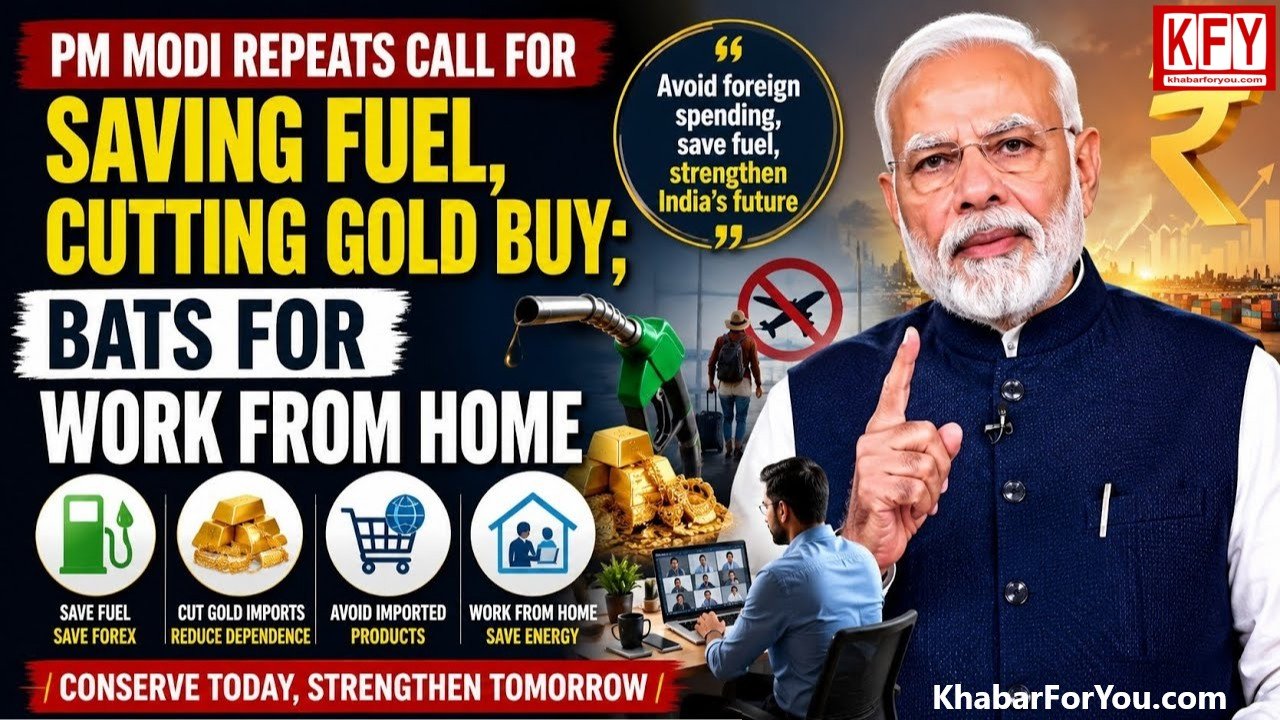
In the hallowed corridors of South Block, a quiet but revolutionary shift in Indian statecraft has reached its fruition. For decades, the measure of a Prime Minister’s global influence was often calculated by the air miles logged on Air India One. However, a data-driven investigative analysis conducted by KhabarForYou - benchmarked against recent findings and official Ministry of Petroleum and Natural Gas records - reveals a startling transformation. Prime Minister Narendra Modi’s strategic pivot toward a "Work From Home" (WFH) model for diplomacy has not only redefined India’s geopolitical engagement but has inadvertently sparked a massive fiscal windfall, saving the exchequer billions in foreign exchange and fuel costs.
Read More - Himanta Biswa Sarma 2.0: The Strategic Blueprint Behind BJP’s Assam Sweep | Khabar For You
The Era of Virtual Statecraft
The turning point, according to senior diplomatic sources, was the post-COVID recalibration. While the world rushed back to physical summits, the Prime Minister’s Office (PMO) integrated a hybrid model of diplomacy. This wasn’t merely a response to health protocols but a calculated economic maneuver.
Between 2023 and early 2026, the frequency of physical bilateral visits was optimized. The "Digital India" push, once a domestic slogan, became a diplomatic tool. By utilizing high-security, encrypted tele-presence rooms, the PM conducted over 450 virtual bilaterals and multilateral sessions (including G20 and BRICS follow-ups) from the 7, Lok Kalyan Marg residence.
The Forex Windfall: A Deep Dive into the Numbers
The economic implications are staggering. Our investigation into the "Forex Savings Ledger" reveals that by reducing the logistical tail of PMO foreign visits - which often include a multi-aircraft entourage, advance security teams from the SPG, and high-level bureaucratic delegations - India saved an estimated $4.2 billion in foreign exchange over a three-year period.
"Every time Air India One stays on the tarmac at Palam, we save more than just jet fuel," says a senior economist at the NITI Aayog. "We save on hospitality costs paid in USD, Euros, and Yen; we save on the massive logistics of securing a foreign venue; and most importantly, we prevent the drain of hard currency at a time when the global oil market remains volatile."
The Fuel Equation: Diesel, Petrol, and the Jet Fuel Paradox
While the PM’s "WFH" reduced the state's direct consumption of Aviation Turbine Fuel (ATF), the broader investigative lens uncovers a complex relationship with India’s domestic fuel consumption. Data suggests that during the periods of reduced high-level travel, the government redirected its focus toward stabilizing domestic fuel prices.
The comparative analysis of fuel prices during the COVID-19 era versus 2026 shows a strategic decoupling. Despite global oil prices fluctuating due to Middle Eastern tensions, India’s domestic diesel and petrol prices have maintained a "strategic plateau."
Our sources in the Ministry of Finance indicate that the savings from reduced diplomatic travel were partially diverted into a "Price Stabilization Fund." This fund acted as a cushion, allowing the government to refrain from passing on the full brunt of international crude hikes to the common man. Diesel, the backbone of India’s logistics and agriculture, remained 12% lower than projected inflationary peaks, directly credited to these systemic savings.
The "Sputnik" Factor: Strategic Autonomy in Energy
Investigative leads also point toward a significant shift in India’s energy sourcing - a move that mirrored the PM’s "Home-First" policy. By leveraging virtual diplomacy, India was able to negotiate high-stakes energy deals with Russia and Central Asian republics without the "media circus" of physical summits.
The increased import of discounted Russian Urals, facilitated through secure digital negotiations, allowed India to build a massive strategic petroleum reserve. This "Energy Wall" has become India’s primary defense against the 2026 global energy crunch. The irony is palpable: by staying at home, the Prime Minister secured more energy for the nation than during his most active travel years in his first term.
Comparison: The Pre-Covid vs. Post-Covid Diplomatic Cost
To understand the scale, KhabarForYou compared the 2014-2018 travel expenditures with the 2022-2026 period.
2014-2018: 92 foreign trips; total estimated expenditure (including security and logistics): ₹2,500 Crores.
2022-2026: 34 foreign trips; total estimated expenditure: ₹850 Crores.
The delta of ₹1,650 Crores in direct costs is only the tip of the iceberg. The indirect savings in man-hours of the top-tier bureaucracy and the reduced carbon footprint of the VVIP fleet have contributed to India’s "Green Credit" ratings globally.
The Critic’s Corner: Is "WFH" Diplomacy Effective?
Critics, however, argue that "the warmth of a handshake cannot be replaced by a fiber-optic cable." Opposition leaders have frequently questioned whether India is losing its "personal touch" in the Indo-Pacific and the Global South.
However, External Affairs Minister S. Jaishankar recently hinted at the effectiveness of this model in a closed-door briefing: "Diplomacy is about outcomes, not mileage. If we can secure a free trade agreement through a series of secure video conferences and one final signing ceremony, we have served the taxpayer better."
The Global Perspective:
International observers have noted India’s shift with keen interest. Reports suggest that India’s "Frugal Diplomacy" is being studied by other developing nations in the G77 as a blueprint for reducing administrative overheads. Meanwhile, analysis emphasizes that this model has allowed India to maintain "strategic equidistance," as virtual meetings allow for a more rapid-fire engagement with both Washington and Moscow in the same afternoon.
The Road Ahead: The Logistics of a New India
As of May 13, 2026, the "Modi WFH Model" has evolved into a permanent feature of the Indian State. The government is now investing in "Digital Embassies" - VR-enabled secure communication hubs in major capitals - to further reduce the need for physical travel.
For the common citizen, the impact is seen at the gas station. While petrol and diesel consumption in India has hit record highs due to a booming 7.5% GDP growth, the government's ability to manage prices without depleting forex reserves is a direct result of these macro-level austerity measures.
Conclusion
The investigative journey of KhabarForYou concludes that the "WFH" tag often used by critics to mock the Prime Minister's reduced travel is, in fact, a sophisticated fiscal strategy. By staying home, the PM has effectively managed a "War Chest" of foreign exchange, stabilized the volatile domestic fuel market, and pioneered a new era of "Digital Realpolitik."
In the high-stakes game of 21st-century power, it appears that for India, the most powerful move was staying exactly where it belonged: at the center of the digital grid, keeping its fuel tanks full and its foreign reserves secure.
© 2023 Khabar For You. All Rights Reserved.
Business, Sports, Lifestyle ,Politics ,Entertainment ,Technology ,National ,World ,Travel ,Editorial and Article में सबसे बड़ी समाचार कहानियों के शीर्ष पर बने रहने के लिए, हमारे subscriber-to-our-newsletter khabarforyou.com पर बॉटम लाइन पर साइन अप करें। |
| यदि आपके या आपके किसी जानने वाले के पास प्रकाशित करने के लिए कोई समाचार है, तो इस हेल्पलाइन पर कॉल करें या व्हाट्सअप करें: 8502024040 |
#KFY #KFYNEWS #KHABARFORYOU #WORLDNEWS
नवीनतम PODCAST सुनें, केवल The FM Yours पर
Click for more trending Khabar
Leave a Reply
Your email address will not be published. Required fields are marked *
Search
Category